Original
The work introduces a genuinely novel idea, method, discovery, theory, technology, or capability.

An international distinction recognising exceptional and demonstrable achievements in quantum science and technology.
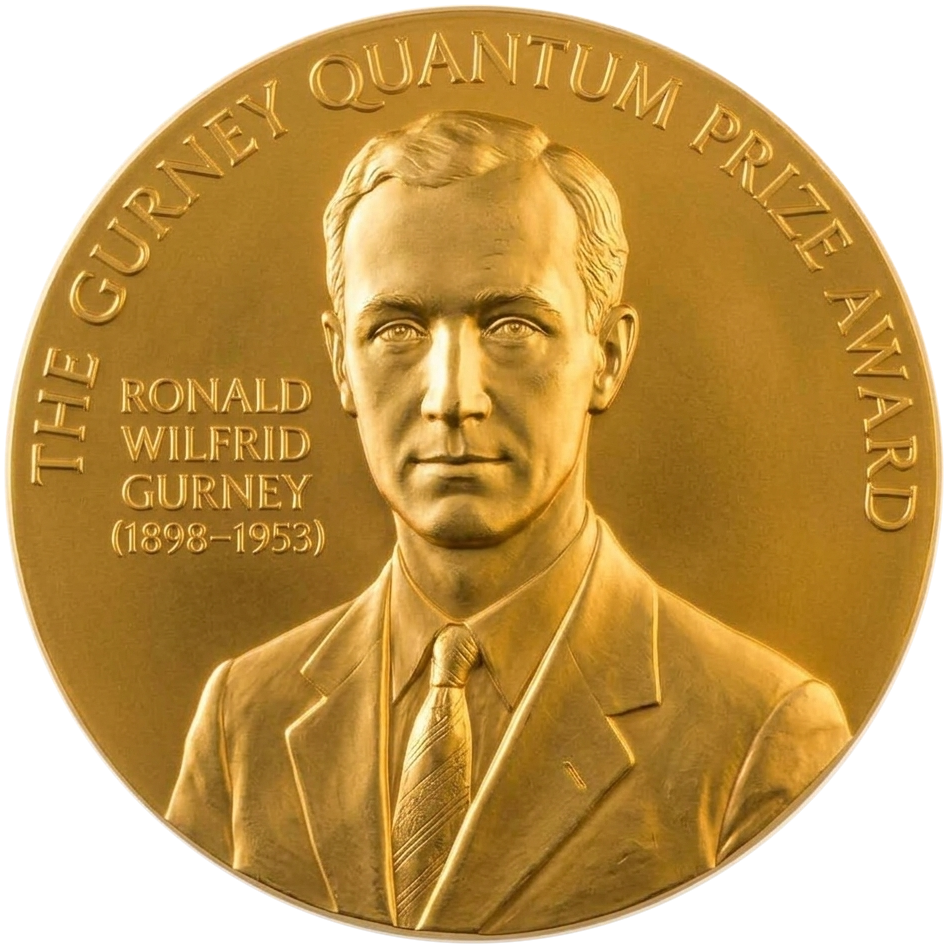
The Gurney Quantum Prize is an international distinction established by CETQAP (Centre of Excellence for Technology, Quantum and AI) to recognise individuals, research teams, and institutions whose achievements represent an exceptional contribution to quantum science, quantum technology, or the advancement of quantum knowledge.
It is an international distinction recognising exceptional and demonstrable achievements in quantum science and technology — not a participation award. It is reserved for achievements that demonstrate exceptional scientific originality, depth, rigor, impact, and lasting significance.
Quantum science is progressing rapidly, yet extraordinary scientific achievements should not be measured simply by publication count, institutional reputation, citation numbers, or media visibility. The Gurney Quantum Prize exists to answer a more demanding question: has this person or team genuinely advanced our understanding, capability, or application of quantum science? The Prize therefore emphasises substantive achievement over popularity.
A candidate may be considered for a fundamental theoretical breakthrough, a major experimental discovery, a significant quantum algorithm, or innovation in quantum computing, simulation, information science, communication, sensing, materials, chemistry, biology, engineering, or software and infrastructure — including a major experimentally validated quantum technology, a discovery that opens a new direction of quantum research, or an exceptional lifetime contribution to quantum science.
Ronald Wilfrid Gurney (1898–1953) was a British theoretical physicist whose career crossed several important areas of early quantum physics, including quantum tunneling, solid-state physics, electrochemistry, ionic solutions, and semiconductor physics. He was associated with the Cavendish Laboratory at Cambridge and worked in the scientific environment surrounding Ernest Rutherford, with early research on quantum tunneling and alpha decay.
In 1931, Gurney published “The Quantum Mechanics of Electrolysis” in the Proceedings of the Royal Society of London (Series A, Volume 134, pages 137–154; DOI 10.1098/rspa.1931.0187). At the time, electrolysis was well described thermodynamically, but the microscopic mechanism at an electrode remained difficult to visualise. Gurney proposed a quantum-mechanical approach: that quantum mechanics permits a finite probability for a particle to transition between states, allowing charge transfer without the classical picture of particles making direct contact.
His theory incorporated quantum-mechanical electron behaviour at the electrode–solution interface, considered the role of the surrounding solvent and ionic environment, and produced a derivation associated with Tafel’s law for hydrogen evolution — making it relevant to the later development of electrochemical kinetics. Modern historical analysis places his contribution decades before some of the better-known developments of modern electron-transfer theory, and researchers continue to describe his 1931 work as a seminal contribution to quantum electrochemistry, including his treatment of electron tunneling and the Fermi–Dirac distribution of electrons in a metal electrode.
Gurney’s broader scientific legacy includes contributions to quantum tunneling, alpha-particle physics, electrochemistry, electron transfer, ionic solutions, solid-state physics, semiconductor theory, colour centres in ionic crystals, and photographic latent-image formation. A recent historical study describes him as the first physicist to apply quantum mechanics to electrochemistry and ionic solutions.
The work introduces a genuinely novel idea, method, discovery, theory, technology, or capability.
Supported by credible methodology, mathematics, experimentation, simulation, or engineering validation.
The work represents more than an incremental contribution.
Claims are supported by evidence that can be independently examined.
Demonstrated or credible potential for significant impact on quantum science, technology, or society.
Preference for achievements capable of influencing the field beyond a short-term publication or project cycle.
The Gurney Quantum Prize is open internationally, and anyone is welcome to apply. Candidates may include quantum physicists, quantum information scientists, quantum computing researchers, quantum engineers, mathematicians, chemists, materials researchers, technology innovators, interdisciplinary researchers, research teams, academic institutions, research laboratories, and independent scientists. A candidate may be self-nominated or nominated by another individual, institution, laboratory, university, or organisation. Nationality, country, institutional affiliation, and geographic location do not determine eligibility — the achievement is what matters.
The Prize is deliberately strict. Holding a PhD, a prestigious position, a large publication or citation count, a large following, media coverage, or having taught or completed a quantum course are not, by themselves, sufficient grounds for the Prize. The Prize recognises achievement, not credentials alone.
Being nominated does not mean selection as a laureate. Only candidates who complete the evaluation and selection process may be designated Gurney Quantum Prize Laureates. The selected laureate receives the Gurney Quantum Prize medal, representing Ronald Wilfrid Gurney’s scientific legacy and the advancement of quantum science.
Anyone is welcome to apply, whether as a self-nomination, a nomination of someone else, a research team, or an institution. Fill in the form below with your achievement and supporting evidence; our team will review your application and contact you by email. Please do not submit confidential information you are not authorised to disclose — for unpublished discoveries, ensure appropriate patent/IP protection or a publication strategy has been considered before submitting sensitive technical details.
CETQAP × Gurney Quantum Prize
For those who advance the frontier of quantum.
The Gurney Quantum Prize